Monday, June 20, 2011

This Sardar Pays A Bribe For Being Innocent !


By Manuwant Choudhary

India's Prime Minister may be a sardar but even innocent sardar's pay a bribe.

Like I saw a crowd of policemen and people on a highway and I inquired what the commotion was all about so the inspector told me that there had been an accident and this large container truck parked alongside was the accused in the FIR.

But I had seen the truck parked there since morning. It had not moved an inch.

So I told the inspector, "Kya paisa kamane nikle hain?" (Are you on your rounds to earn money?)

The inspector sheepishly promised, "Sir, thana paisa nahin lega." (Sir, the police station will not take money.)

The police wanted to move the truck and the truck driver protested because if he moved his truck the only evidence he had that he was not involved in the accident would be destroyed.

Since it had rained just after the accident and the underside of the truck was a dry spot meaning the truck was stationed there before the rains.

But the police forced himto move.

For a few days the police said they were investigating the matter.

Some 200 local people gave in writing that the truck was stationed since morning. But the DSP refused to believe them.

And round the clock a chowkidaar was posted to guard the truck.

Everyday I told the chowkidar as to why he worked for thieves.

The chowkidar would get onto his cycle and and rush to the police station to complain that a person said the police are thieves.

The local DSP argued that 200 witnesses were not enough evidence.

He wanted money.

A few mechanics acted like go-betweens, pretending to support the truck driver, but convincing him that it would be better that he pays the DSP rather than be dragged into the case.

Just then the owner of the truck sent a fax - a copy of the printout - of the satellite GPS system which was installed in the truck.

It gave minute by minute account of the trucks movement.

It had not moved at all on the day of the accident.

The DSP settled for Rs.1100 ! (Eleven hundred rupees)

I asked the truck driver why he paid when he was innocent.

He replied he had no choice as he would be harassed by the police on this route everytime.


I asked him whether he was aware a sardar was India's Prime Minister.

He said, Yes.

I asked, "And you still pay a bribe."

I told him not to pay a bribe.

Only then can this country become great (Mera Bharat Mahan !)

Forget Anna Hazare and Manmohan Singh and the Ramdev Baba's and their committees.

I am the Lokepal.

You can be a Lokepal too.

Lock-up the police stations and 50 per cent of corruption will stop.

Sunday, June 5, 2011

The Royal October Wedding


31-year-old Bhutan's King Jigme Khesar Namgyal Wangchuk is all set to marry Jetsun Pema, who studies at London's Regent College, this October so all weddings in Bhutan have been cancelled till their beloved king announces a wedding date and gets married. This means no weddings in Bhutan till October. Just wonder what would happen to our economy if Indians decided to wait for Rahul Gandhi to get married!

I am not sure about Bhutan's Gross Domestic Happiness but the Royal couple sure look happy.

Friday, March 25, 2011

India Raids Holy Money To Karmapa - 5


By Manuwant Choudhary

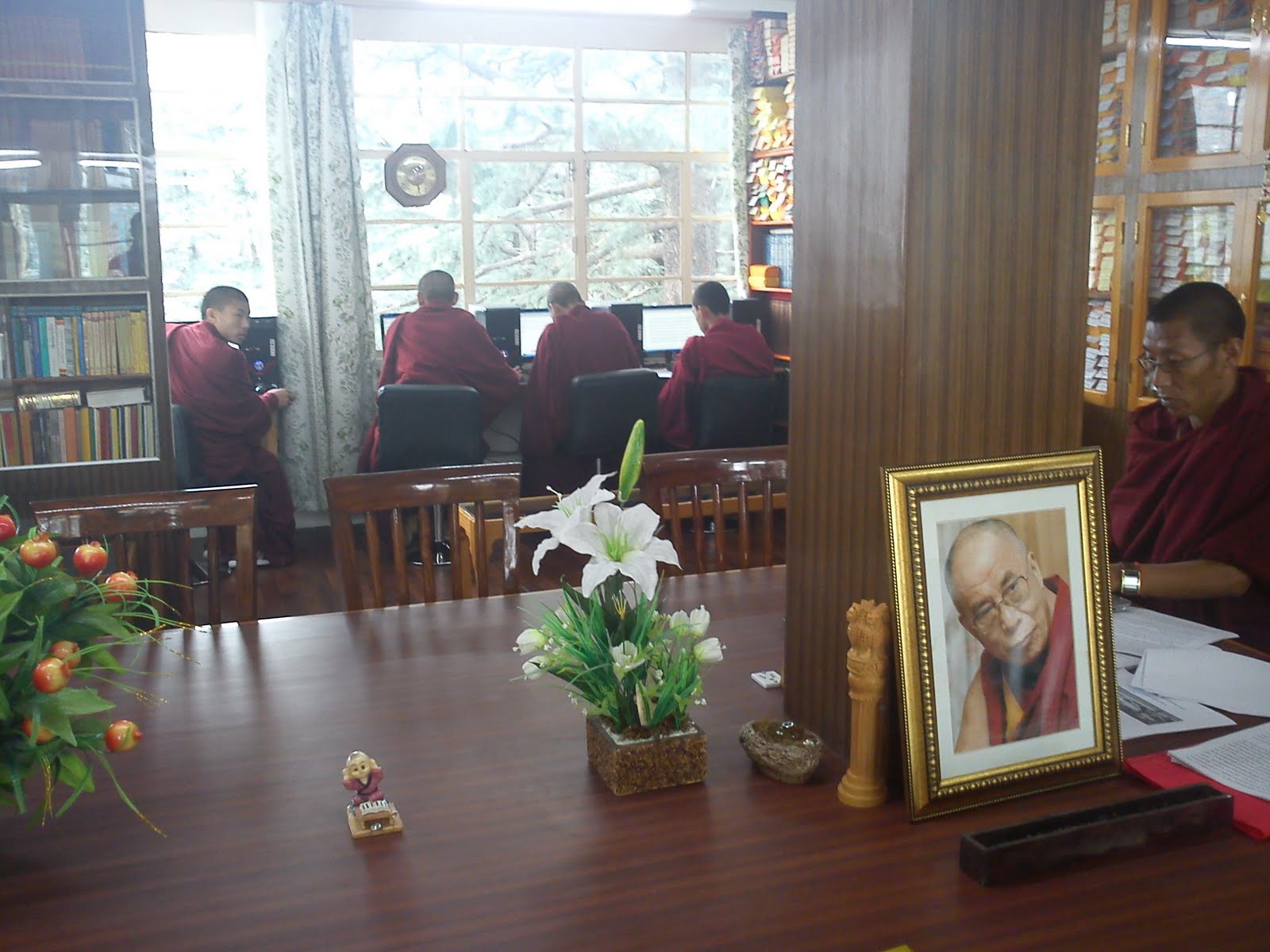
McLeodganj, Dharamsala: I envy the monks who sit on their computers overlooking the pines at the Dalai Lama Trust study room but am sure the Chinese hate this place and must be sending a million viruses to bug the Dalai Lama's computers.

As a journalist I have had a few extraordinary encounters that are still memorable.

One event was being pushed around by Tibetan women bodyguards of the Dalai Lama at Bodh Gaya even as we tried to get close enough to attract the Dalai Lama's attention, the women bodyguards were tough and rude but effective, "What journalist? We know no journalist."

So we were sent back some hunderds of metres away but even as the Dalai Lama emerged journalists shouted at the top of their voices, "His Holiness, His Holiness, His Holiness!"

And to our delight and surprise His Holiness looked at us and contrary to the itenary came towards us.

Hordes of cameras clicked away while TV crew pushed mikes into his face.

And His Holiness said, "Ask."

There was silence.

He smiled, "Ask. ask."

Complete silence again.

His Holiness laughed this time, "Questions, please."

Nothing came from the journalists who expected the Dalai Lama to give a sermon.

Just then I realised what the problem was...all the journalists there were Hindi speaking and they simply did not know English.

So on the spur of the moment I asked some 6 questions.

The Dalai Lama for the first time spoke out against the war in Iraq.

There was so much insecurity in the world that I asked his what is security and the Dalai Lama pointing to the gun weiliding bodyguards around him laughed, "This, this, no security."

He went on to explain perhaps like no one has what security means to the individual.

A rare insight into a great mind.

He looked me in the eye.

I have also seen the Dalai Lama being greeted by lakhs of Tibetans who worship him, and I can think of no individual who has shouldered his responsibilities as well as he has.

I asked him who will be the next Dalai Lama?

And he had replied, "I will be the last Dalai Lama."

Then added, "Tibetans should elect their leader. They can call him the Dalai Lama if they want to."

It is this democratic views of the Dalai Lama that really scare the Chinese.

The Chinese say they do not recognise him, yet they spend all their propoganda machine trying to target the Dalai Lama.


Over the years I have somehow become a pilgrim of peace.

I have been lucky to meet a few Nobel laureates like the Dalai Lama and South Korea's late President Kim Dae Jung.

Outside the Dalai Lama house is the familiar wooden post `May Peace Prevail On Earth."

Just as health is most important to an individual, peace is most important for the world.

I have also had an opportunity to visit the International Court of Justice at the Hague, where they have this post outside.

And I want to meet the brave lady of Burma Aung San Suu Kyi one day.


Near the Dalai Lama house is a museum of rare photographs. If you do visit Mcleodganj you cannot miss them. There are rare photographs of the Dalai Lama escaping from Tibet and about brave Generals who died fighting the Chinese.


I watched a film there. There were just three persons in the audience, the other two were westerners.

It was called `Red Flag Over Tibet."

I cried.

Saturday, March 5, 2011

India Raids Holy Money To Karmapa - 4


By Manuwant Choudhary

McLeodganj, Dharamsala: I wanted to see the Tibetan parliament so I wandered down a path but I suddenly found myself surrounded by a million prayers.....a solitude...when even if you don't believe in God..you can feel his presence....a strong breeze made the prayer flags flutter....

I felt this once before at Kedarnath when I walked across the snow to the temple for the evening aartee. I had said, "If God exists, he lives here."

Many years later when I worked at the Afternoon Despatch & Courier, my editor Behram Contractor wrote a piece on Kedarnath saying the same `If there is God, he lives at Kedarnath'. Mr. Contractor was a Parsi and he had visited Kedarnath many years before I did.

As I stood amongst the fluttering prayer flags I felt closer to `The Maker'.

I also thought about distant Tibet.

The breeze carried with it something of Tibet.

I thought about the strange world of Tibetan buddhism where faith in non-violence is stronger than a rock....even thorns had prayer flags tied around them.

I thought about the world of incarnations and whether it was real.

Was it just a succession plan?

Does one have a past life?

Or a rebirth?

Why do we do what we do?

Why do we fall in love?

Why do we not fall in love with everyone?

What was I really doing at McLeodganj surrounded by these prayer flags, overlooking the breath-taking view of the plains.

From here it made everything that goes on in the world really petty....


I entered very briefly into the world of Tibetan Buddhism.

It is said that Buddhism came to Tibet in the reign of King Trisong Detsen - 755 CE, wherein Buddhism becomes Tibets official religion. It was the King who had invited famous Indian teachers like Shantarakshita and Padmasambahava to Tibet.

Until then the religion followed in Tibet was Bon.

It was Padmasambhava - a master of Tantra - who is credited with spreading Buddhism in Tibet. He built the Samye montastery and his influence on develpment of Tibetan Buddhism is incalculable. He was also referred to as Guru Rinpoche.

Nyingma - the oldest among the four major Tibetan Schools of Buddhism - claims Guru Rinpoche as its patriarch.

According to legend when Guru Rinpoche arrived in Tibet he pacified the Bon demons and made them protectors of `Dharma'.

Then comes the Kagyu sect, of which the Karmapa is the 17th descendant, so its the oldest lineage. The Karmapa is discovered only through letters left behind by the previous Karmapa..which should cite the time, year, place of birth..and other clues to enable high monks to find the incarnation.

Then comes the Gelug or the `Yellow Hat Sect'..the Dalai Lama is their spiritual leader and they value `compassion' the most.
It is said that a high lama from this sect Sonam Gyatso converted Mongol Altan Khan to Buddhism and it is bleieved that he gave the name to him Dalai Lama or `Ocean of Wisdom' in 1578. Sonam Gyatso was the 3rd Dalai Lama. The first two got their title posthumously.
Later Gashri Khan declared himself King of Tibet and in 1642 recognised the 5th Dalai Lama as spiritual and temporal leader of Tibet.

But again there is another theory which suggests the Dalai Lama existed before the invasions of the Mongols.

Then there is the Sakya whose head is Nawang Kunga Thekchen Rinpoche (born 1945) and their headquarters are at Rajpur in Uttar Pradesh.

THE KARMAPA CONTROVERSY

There are two claimants to being the Karmapa.

1) Trinley Thaye Dorje, born May 6 1983 at Lhasa, Tibet, and it is said that when he was 6 years old he began saying that he was the Karmapa. So in 1988 Shamar Rinpoche went on a secret visit to Lhasa since the boy appeared to him in a dream. In March 1994 Trinle Thaye Dorje escapes from Tibet to Nepal and then to India where Sharam Rinpoche recognises him as Karmapa. He lives at Kalimpong and apart from Tibetan studies he receives western education as well.


2) Ogyen Trinley Dorje, born June 26 1985, in eastern Tibet, he was born to nomadic parents who moved from one place to another...but his parents found his behaviour unusual when he insisted that his parents move camp early.

Thus when the search party came they found the boy in exactly the same place as was predicted in the letter handed down from the 16th Karmapa..he was recognised as Karmapa at the age of 7.

Tai Situpa gets an intution and finds a prediction letter in an envelope marked "Open in Metal Horse Year." Letter said the Karmapa was to be reborn `to the north, in the east of the land of the snow.'

Is a country where divine thunder spontaneously blazes.

In a beautiful nomad's place with the sign of a cow,

The method is Dhondrub and the wisdom is Lolaga.

Born in the year of the one used for the earth.

With the miraculous, far-reaching sound of the white one, is the one known as Karmapa.

Ogyen Trinley Dorje's mother's name is Loga and father is Karma Dondrub Tashi.

In June 1992 he moved to Central Tibet to Tolang Tsurphu Monastery - main seat of all previous Karmapas..

The Chinese recognsed him as a Karmapa.

So did the Dalai Lama who says he had a dream about the area where the Karmapa was found. Although the Dalai Lama has no say in lineage of other sects, lineage itself is extremely important in Tibetan Buddhism since tradition is sustained through teachers passing along their knowledge and wisdom to the next generation of disciples..

In 1999 the Karmapa Ogyen Trinley Dorge escapes from Tibet and arrives in India. Here he is warmly received by the Dalai Lama and the Indian government grants him asylum.

However, the Sharmapa Rinpoche refused to recognise him.

The first Karmapa & Sharmapa Rinpoche control the Karmapa Trust but have no control over the Rumtek monastery in Sikkim.
The monks who control the Rumtek monastery support Ogyen Trinley Dorje as the Karmapa. The matter has now gone to India's Supreme Court.

The Dalai Lama held a meeting with the Sharmapa Rinpoche to resolve the dispute for the sake of all Buddhism.

Ogyen Trinley Dorje met the Sharmapa Rinpoche at Oberoi International Hotel in New Delhi on January 9 2007..and the Dalai Lama met the Sharmapa on August 13 2010 and the Sharmapa promised to work towards an amicable solution, "Although this matter is not easily resolved since it is connected to the politics of China and India....."

The 16th Karmapa wrote this song in 1940.

In the springtime, a cuckoo comes as guest.

In the fall when the harvest ripens, it knows where to go.

Its only thought is travel to the east of India.

In the lofty land of Tibet, inhabitants high and low,

And in particular, you, Tai Situ the Lord and Protector of Maitreya,

Who remains above the crown of our head,

May your activities, like the sun and moon set in space,

Be continuous, stable and without hindrance.

I pray that we meet again and again.

(Credits to Wikipedia)

Wednesday, March 2, 2011

India Raids Holy Money To Karmapa - 3


By Manuwant Choudhary

McLeodganj, Dharamsala: Even as the Indian media cover the Karmapa issue like a cheap spy-thriller, this action of the Indian government in attempting to portray the Karmapa as a `Chinese spy' has hurt all Tibetans.

The Karmapa in his decade of exile has not said a word against the Indian government or against the Dalai Lama.

India is of course jittery that the Chinese have sent the Karmapa to India to gain control of the rich Rumtek monastery.

And what happens when the Karmapa succeeds the Dalai Lama as the spiritual and political heir of the Dalai Lama and says that the Chinese government is doing great work giving jobs to the Tibetans?

Questions and more questions.

But the real question is that is the secular Indian government meddling in Tibetan religious affairs only to control the Karmapa?

They have accused the Karmapa of violating foriegn exchange rules and also that he wanted to buy benami properties to build a monastery.

But while this may appear to be news to Indians, at Dharamsala itself this is an old issue and the Tibetan government in exile has been in talks with the Himachal Pradesh government to relax the rules to enable Tibetans to buy land openly.

Its ironical that while the BJP activists campaign against article 370 which grants special status to Kashmir, denying Indians the right to buy property there, it doesn't talk about section 118 Himachal Pradesh Tenancy & Land Reforms Act which is an old socialist act, which says only farmers can buy land in Himachal Pradesh.

Yes, you got that right even Himachali businessmen need government permission to buy land.

As for the Tibetans, India's first Prime Minister Jawaharlal Nehru granted asylum, successive Indian governments have not addressed core issues faced by Tibetans. In 50 years their population has increased and surely they cannot live at refugee colonies all their lives.

They also have larger families to support so they become hotel oowners or run restaurants or sell wollens, many such businesses require land.

But Titebans were not allowed to buy land.

So like the Tibetans, the issue of the Karmapa should not be viewed from a purely legal viewpoint.

Surely, the Karmapa does not have a Chinese passport !


Near the Dalai Lama residence is a Buddha temple, and outside I watch a 3-year-old Tenzin Chechup plays with an Indian child.

I wondered what Tenzin would grow up to be.

Just a refugee - a child with no country.

I also wondered whether he would be as freindly to Indians when he grows.

Or will he be angry?

Would he even question his faith?

Tenzin's future lies in what we Indians do to him.

How our governments treat him?

So with all these questions I went to meet another Tibetan Member of Parliament Mr. Dawa Tsering. He also runs a school called Yongling School.

As I arrived at the school kindergarden school children greeted me with a smile and a `Namaste'.

When I just smiled at them, they became a chorus and shouted `Jee Maharaj' and burst out laughing.

It was clear they love to watch TV serials like the Mahabharat where courtiers worship their kings.

But Tibetans are no courtiers and hence the glee.

Tibetans are independent and free.

They want to return home but with self-respect and dignity and freedoms.

Never without.

By evening Mr. Dawa Tsering was at home. The first time he entered the Tibetan parliament was as a nominee of the Dalai Lama himself.

But through his years as Mayor of Mcleodganj and social works in the area he has a greater understanding of the problems faced by the Tibetan community.

He said, "The Tibetans did not buy the benami lands on their own, its their Indian friends who showed them a loop-hole in the laws that would enable them to get on with their lives."

Mr. Dawa Tsering explains, " the Indian government should have a policy that if a refugee is born here then he should be allowed to buy land."

Since 1996 Mr. Dawa Tsering has been campaigning for land rights to Tibetans.

But the Himachal government said that the only way to legalise benami transactions was for the Central Tibetan Administration to first submit them a list of the benami properties which the HP government would acquire and then lease it back to the Central Tibetan Authority after they pay 10 per cent of the market rates to the HP government.

So after years of struggle the Tibetans submitted a list of 70 benami properties, both individuals and institutions, and a cabinet order was passed on May 8, 2005, under Clause 3 of article 348 of the Constitution of India as a one-time settlement.
Later on a case to case basis also the HP government would grant permissions for buying land.

Said Mr Tsering, "So the Karmapa also has applied for permissions to buy land."

But the process is slow and even Tibetans are lazy about it all. "Its so much easier to give money and buy land."

Mr. Dawa Tsering's father served in the Indian territorial army and talking to him we did not see the time, until we found dinner on our tables in front.

Mr. Tsering is a vegetarian.

After a long day I relished the home-cooked chicken curry and rice.

I asked Mr. Tsering whether he enjoys his life as a Tibetan MP and what do the MPs do? His reply, "Often we have MPs taking credit for works completed months ago by someone else."

As I walked through the dark to my hotel I wondered why the Indian government agreed to stop talking about Tibet when China said that Sikkim is an integral part of India.

Its not the Karmpa, but the Indian government which has sold out to the Chinese.

We have abandoned Tibet.

Wednesday, February 9, 2011

India Raids Holy Money To Karmapa - 2


By Manuwant Choudhary

McLeodganj, Dharamsala: Drinking ginger tea with a Tibetan Member of Parliament-in-exile at the Chonor House overlooking a spectacular view of the hills and the plains beyond, one would have thought Tibetans are happy being sheltered in India.

They are happy to escape the Chinese occupation and oppressions in Tibet and in India they are free to practice their religion and breathe easy.

Recently, the Dalai Lama said while China used every means to control the Tibetans, the Tibetans in Tibet look towards India.

But it has been 50 years since the Dalai Lama fled China into exile and the younger Tibetans are getting impatient. Last year they even attempted to walk back to Tibet but the Indian police arrested them.

And for 50 years not a single Tibetan has got Indian citizenship.

On December 22 2010 the Delhi High Court gave a landmark judgement after a young 25-year-old Tibetan girlNamgyal Dolkar approached the High Court as she was being denied an Indian passport.

The Delhi High Court ruled in her favour due to a changed citizenship rule which allowed citizenship under naturalisation to all those who arrived here before 1986 and their children.

In the case the Ministry of Exernal Affairs had argued that according to a ministry of Home Affairs policy decision that a Tibetan who enters India after 1959 will not be given citizenship under naturalisation under Sec 6 (1) of Citizens Act. Only by marriage to an Indian can the case be considered for citizenship.

According to the Demographic Survey of Tibetans-in-Exile 2009 the total population of Tibetans outside Tibet is 1,27,935.
This includes 70,556 male and 57,379 female.

94,203 live in India.
13,514 in Nepal.
1298 in Bhutan.
18,920 elsewhere.

It is noticed that Tibetans in the United States and Canada do not resist taking that countries passport.

So i asked Mr. Penpa Tsering how Tibet's parliament-in-exile views the citizenship issue and he replied, "We welcome the Delhi High Court order but we think its a personal choice whether Tibetans want the citizenship or not."

But what about the disadvantages in not being an Indian citizen, and he replied, "We do get private jobs easily but yes we cannot get government jobs. Also sometime at educational institutions we are treated as a foriegner."

Tibetans do not vote in the Indian elections, either.

They vote for their own Tibetan parliament-in-exile.

The reason I am going to such detail is not to bore you but to bring home certain truths about life as a refugee.

The Tibetans may have escaped Chinese occupation and violence to a free India, but even here the bureacratic oppression they face is formidable.

Some of this bureacratic opression is faced by every Indian as well.

I have always wondered why this bruhaha over the money found at the Karmapa residence when in fact the Karmapa himself entered India illegally, crossing over the Himalayas, I am sure he doesn't have a Chinese passport.

It is the Indian government who granted him asylum.

So it is also teh Indian government who should have made sure that all his legal requirements are met so that the Karmapa can live and stay in India without a hitch.

The Karmapa is not an ordinary person. He heads the religious sect so it is natural people from aroundthe world will come to him.

I had covered the Karmapa on his first visit to Bodh Gaya and at the Gaya train station as he got out he smiled.


There were a dozen intelligence officials accompanying him and he has never really been on his own.

At McLeodganj he lives in a temporary accomodation under Indian security, virtually under house arrest.

Every move is watched.

In a decade just once he was allowed foreign travel to the United States of America for 15 days only.

A Chinese spy being allowed foreign travel?

India's government is in trouble and it must be liberal in its use of legality and not misuse government machinery to harrass the Karmapa and confiscate money meant for the poorest of the poor.

Tuesday, February 8, 2011

India Raids Holy Money To Karmapa - 1


By Manuwant Choudhary

McLeodganj, Dharamsala: The road leading to the Dalai Lama's residence has always been busy but this time there is an unease evident as I take a photo of the Karmapa from a CD being sold on the roadside, the young tibetan CD seller Nwalkho burst out almost apologetic, "You are taking his photo because of all the foreign money found at Karmapa residence. It was so simple...they just had to take it to the bank and put it there."

Not quite simple as that.

But to the simple minds of Tibetans a daily shout from the Indian media saying their Karmapa is a Chinese spy has shocked them but with a confused disbelief.

A Ladhaki Buddhist girl said, "So many TV crew are on this road but no one speaks to them. Everyone is so scared."

I travelled to Mcleodganj, which is on the upper reaches of Dharamsala, to tell the other side of this story.

So I met Mr. Penpa Tsering - a Member of Parliament of the Tibetan Parliament in Exile. The Tibetan parliament meets only twice a year in September and March. But when there is no parliament in session there is an 11 member standing committee of parliament empowered to take important decisions.

So when the story broke that 6 crore rupees worth of money was found at the Karmapa residence which included money from 25 foreign countries, the 11 member committee led by Mr. Penpa Tsering met on January 28, 2011.

Mr. Penpa Tsering is the Speaker, "We met and discussed the matter following which we met the Karmapa and found him to be in a calm mood. We went there to not just enquire but also to express our solidarity with him."

The Karmapa's first reaction on meeting the committee was, "I do not know whats really happening."

He then told the committee, "I do not deal with financial matters."

It is at the age of 16 in late 1999 that Ogyen Trinley Dorje escapes from Chinese controlled Tibet into exile to India. He first meets the Dalai Lama on arriving in India and the Indian government grants him a refugee status.

Mr. Tsering explains, "the Tibetan-parliament-in-exile does not interfere with the workings of the various religious sects, but one thing we can say is that the Karmapa is not a Chinese spy."

"The money that has been found is simply the offerings made to him by his followers. "

Initially when the Karmapa arrived, a trust was set up in 2003 called the Saraswati Trust. Then in 2006 another trust was set-up called the Karma Garchae Trust and in 2009 it is the Karma Garchae trust that applied for blanket permission for recieving foreign contributions under Foriegn Contributions Regulations Act.

But so far the permissions have not come.

Mr. Tsering goes on, "Then there is something called the Labrang. All high Lamas have this and this is basically unregistered and under the management committee of the monastery. All offerings collected by the Labrang personnel are put in a box and on a given day the responsible persons of the Labrang make an inventory of offerings."

"Since the FCRA permissions have not come in they cannot go and deposit it in the bank or return it to the disciples who made the offerings."

Mr. Tsering says the Tibetan parliament-in-exile holds that the Karmapa is personally not involved in this and even as patron of the trusts his name is not there on the Trust Board. "Earlier it was there but it was later removed since patrons cannot be on the Trust Board."

The Himachal Pradesh police have seized the 6 crore rupees and arrested Shakti Lama(alias Chosang Dhargy), the cashier to the Labrang. They also detained a property owner Mr. Bhardwaj but released him later but detain two of his representatives.

The Himachal Pradesh police suspect Karmapa's china links because of the Chinese Yuan's found, but Mr. Tsering says, "Of the 6 crore rupees found less than a crore was Chinese Yuan. There are Buddists in China also and even Tibetan pilgrims from china offer Yuans."

Police are probing a hawala angle to this.

But on the interpol website there is an interesting case study which says Hawala is a legitimate way to transfer money and it existed long before the banking system came into being. You could give the money to an agent in one country and the beneficiary would recieve it in another country by another agent without the money having actually travelled.

So in the case of the Karmapa, money has travelled from 25 countries, hence its not hawala.

It is money brought in by pilgrims and offered to the Karmapa, unsolicited.

If it was hawala money would have come to him in Indian currenny and he would have deposited the same in the banks without any fuss.

The Dalai Lama who has himself had an unblemished 50 years in India as an exiled leader has said the money is for charity.

The Karmapa on his arrival in India had gone straight to meet the Dalai Lama and the Dalai Lama had received him warmly.

The Dalai Lama has done more for India's positive image than all our politicians and I am not sure why we want to fritter away the goodwill.

The Tibetans have been grateful to India to a fault.

I am a critic of Jawaharlal Nehru but his single great act was to grant asylum to the Dalai Lama and his people fleeing Chinese oppression, even at the risk of the Chinese declaring war on India.

But todays Congressmen have no such courage.

India's home minister Mr. P Chidambaram says this on the Karmapa, "I have not concluded anything so I cannot share my conclusions with you."

But I have not heard the Indian government say anything on the Karmapa.

The Chinese government says the Karmapa is not a Chinese spy and India's suspicion only indicates India's deep distrust towards China.

The Indian media say the Karmapa plans to build `China freindly' monasteries across the Himalayas.

I disagree.

I would think we have a `China friendly' government.